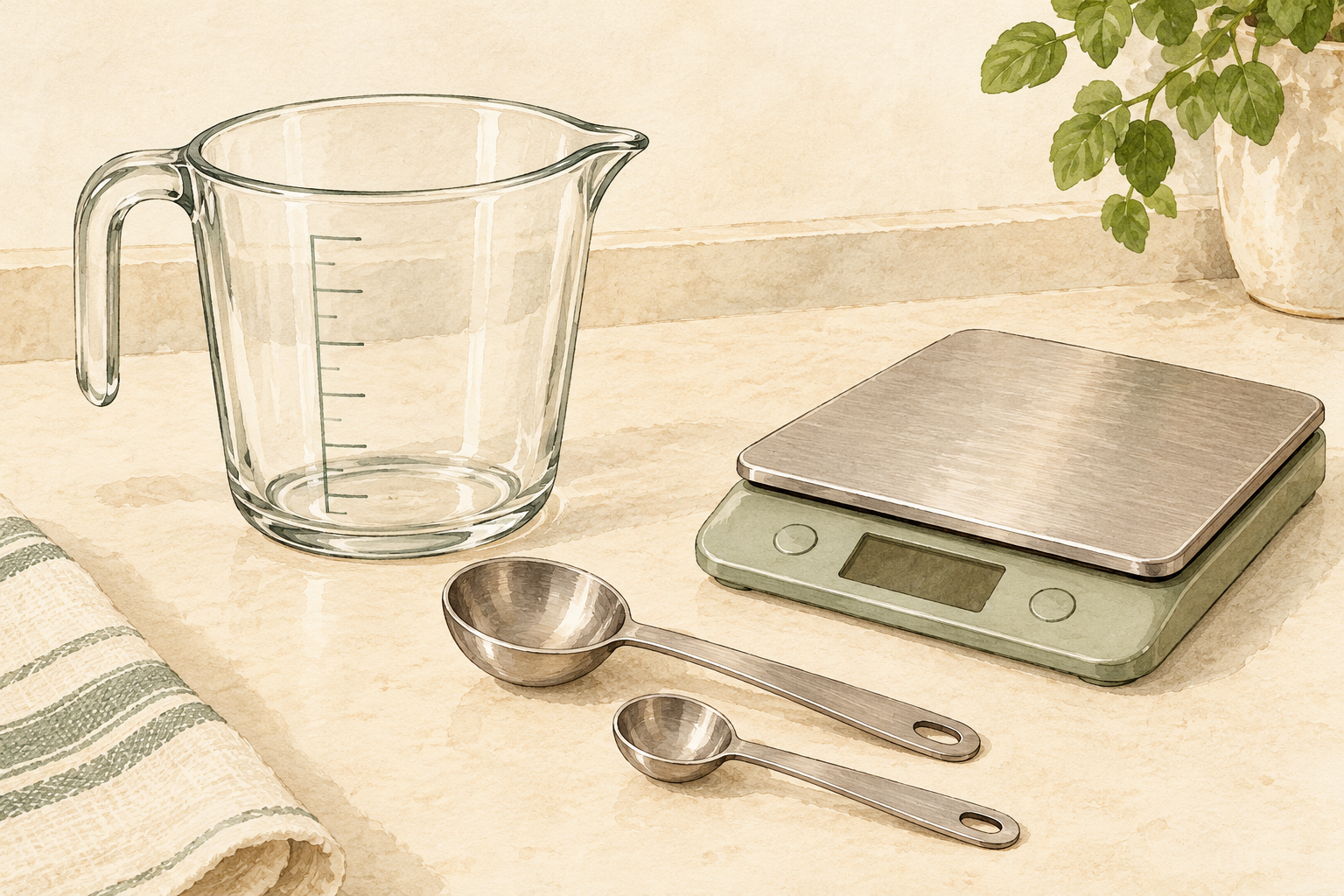
Accurate measuring begins before the first ingredient reaches a jar. A recipe may use volume for liquid, weight for vegetables and a named salt measured with spoons. Treating all three as interchangeable can change the formula. This guide helps you follow an existing recipe accurately; it does not supply a new brine ratio or validate a canning adaptation.
Check which cup the recipe uses
A cup is a unit defined by the recipe’s measurement system, not whichever drinking mug is nearby. Different publications use different conventions. Check the source’s notes and use its supplied metric quantities when available. If the source leaves a safety-critical conversion ambiguous, ask the publisher or choose a clearly specified recipe instead of silently mixing measurement systems.
Our published refrigerator recipes state a 240 ml cup, a 15 ml tablespoon and a 5 ml teaspoon where those units apply. That convention belongs to those recipes. Do not retroactively apply it to a different source that defines its units another way.
Measure liquid at the marked level
- Place a suitable liquid measuring jug on a flat surface.
- Read the mark at eye level rather than while holding the jug at an angle.
- Measure each liquid separately, using the units and amounts in the recipe.
- Check vinegar acidity on the bottle as well as its volume. The correct volume of the wrong-strength vinegar is still the wrong ingredient.
Keep water and vinegar entries separate on your preparation sheet so you do not accidentally swap them. If you lose track of an ingredient already poured into the mixture, stop and resolve the uncertainty; adding more by taste does not reconstruct the original measurement.
Weight and volume answer different questions
Grams measure mass; millilitres measure volume. A simple gram-for-millilitre substitution is not a general kitchen conversion. Likewise, a cup of finely cut vegetables may hold a different mass from a cup of large pieces. Salt crystal size can also change how much fits into a spoon. Use the ingredient, preparation and unit the source specifies.
A scale is useful when the recipe supplies weights: put the empty bowl on it, tare to zero and add the specified ingredient. A scale reading cannot supply a missing target weight. Do not invent one by weighing a convenient spoonful and declaring it an approved substitute.
Read the preparation words
‘Prepared cucumber slices’ means the measurement is taken after the specified preparation. ‘Whole cucumbers’ may be a different instruction. Highlight words such as trimmed, peeled, drained, packed or loosely filled before starting. If two parts of a recipe contradict each other, do not choose whichever amount fits your jar.
Jar capacity and recipe yield also differ. A 500 ml container does not call for 500 ml of vegetables plus 500 ml of liquid. Use the source’s food quantity, liquid formula and packing instructions. If the expected batch does not fit, do not dilute the liquid or force in extra food to make the numbers look tidy.
Use a short pre-mixing check
- Source and version are recorded.
- The recipe’s unit convention is understood.
- Vinegar strength and salt type match the ingredient list.
- Vegetables are measured at the preparation stage specified.
- Each quantity is checked off only after it has actually been added.
Frequently asked questions
Can I scale a canning recipe with a calculator?
Arithmetic alone cannot validate a changed preservation process. Follow the source’s permitted batch size and directions, including jar size and altitude adjustments. Choose a suitable tested recipe when the source does not support the change.
What if I added too much water?
Do not try to repair a preservation formula by tasting it or guessing an acid addition. Stop before using it and consult the recipe source for a supported correction, or prepare a fresh correctly measured mixture. A sour taste is not an acidity measurement.
Sources and related reading
Reviewed 30 October 2026: NCHFP’s ingredient-proportion guidance and Oregon State University Extension’s Pickle Fact Sheet. The workflow examples are editorial preparation aids, not tested preservation formulas.
Continue with salt type and measurement, vinegar acidity labels and evaluating a recipe before starting. Featured artwork is an original AI-assisted illustration and should not be used as a calibrated measuring reference.