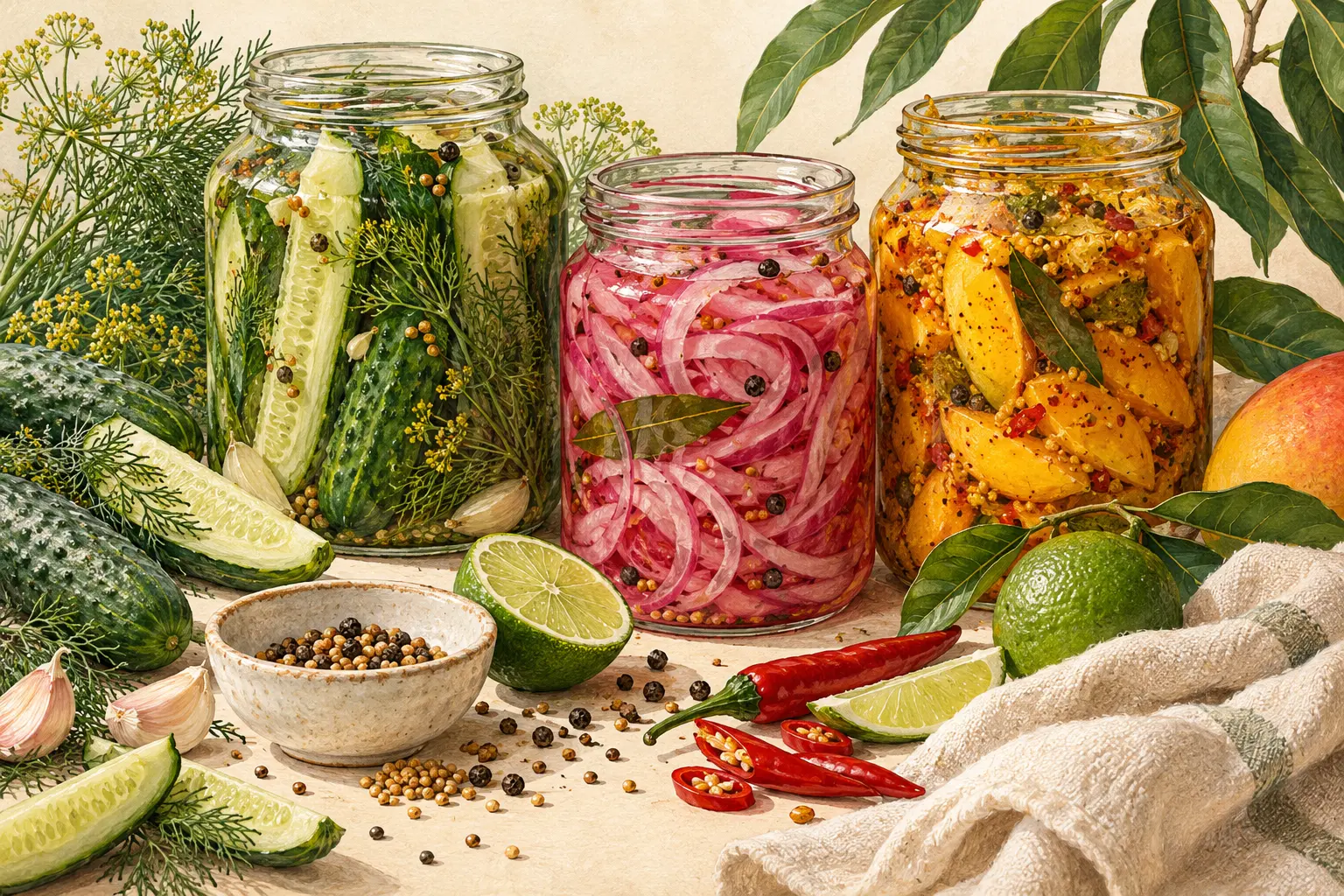
A useful recipe tells you both how to make the food and how to handle it afterwards. Before committing ingredients to a large batch, spend a few minutes checking the source, quantities and intended preservation method.
Match the source to the claim
For home canning, choose a research-tested recipe from a preservation authority such as USDA, NCHFP or a university extension service. An attractive photograph, popularity or a family history does not establish a tested processing method. A food writer can offer useful flavour ideas without that being evidence of safe long-term pantry storage.
Look for complete quantities
Read the ingredient list for measured produce, acid, salt and water, including the vinegar acidity where relevant. Check whether quantities refer to whole or prepared vegetables. Vague instructions such as add enough vinegar or cover with oil cannot replace tested proportions for preservation. Do not fix omissions by borrowing amounts from a different vegetable recipe.
Read the whole process
A canning method should specify the relevant preparation, packing, jar size and processing details, including altitude adjustments. Fermentation needs its own complete conditions and monitoring. A refrigerator recipe must plainly require refrigeration. If the written method does not support the storage claim at the end, choose another source before starting.
Separate flavour adaptations from preservation validation
A change to a seasoning is not the same as a change to a safety-critical ingredient or process. Read the source’s own permitted variations. Do not assume that a recipe remains tested after changing its food-to-liquid balance, cut size or processing. Our published adaptations identify their scope and do not claim PickleRecipes kitchen testing or validated shelf-stable preservation.
Check whether the article is internally consistent
Compare ingredient quantities with the steps. Does every required ingredient have a clear use? Do timing and yield make sense for the stated container? Are cold storage and waiting time distinguished from active preparation? A contradiction is a reason to pause and ask the source, not an invitation to select whichever instruction is more convenient.
Keep the version you used
Save the source link and access date and record any explicit permitted option you selected. If you later ask for help, that record is more useful than saying you followed a recipe online. For a first batch, prefer a complete, modest-sized project. You can make another batch after assessing the result rather than increasing an uncertain formula immediately.
Source and scope
Consulted 28 October 2026: NCHFP: Safe home canning and tested recipes. This guide is not a stand-alone preservation recipe or a way to certify an uncertain batch.
Continue with this related article, or browse the Recipe Library. Original pantry illustration by PickleRecipes; not a photograph of a tested batch.
Preparation guides for your next batch
- Choose a suitable container before heating brine or preparing vegetables.
- Understand pickling spice blends and how they differ from salt or commercial pickle mixes.
- Compare cucumber types with the produce your recipe specifies.
- Check ingredient measurements, including the source’s units and preparation stage.
- Label the jar and record the batch using the recipe’s actual storage directions.