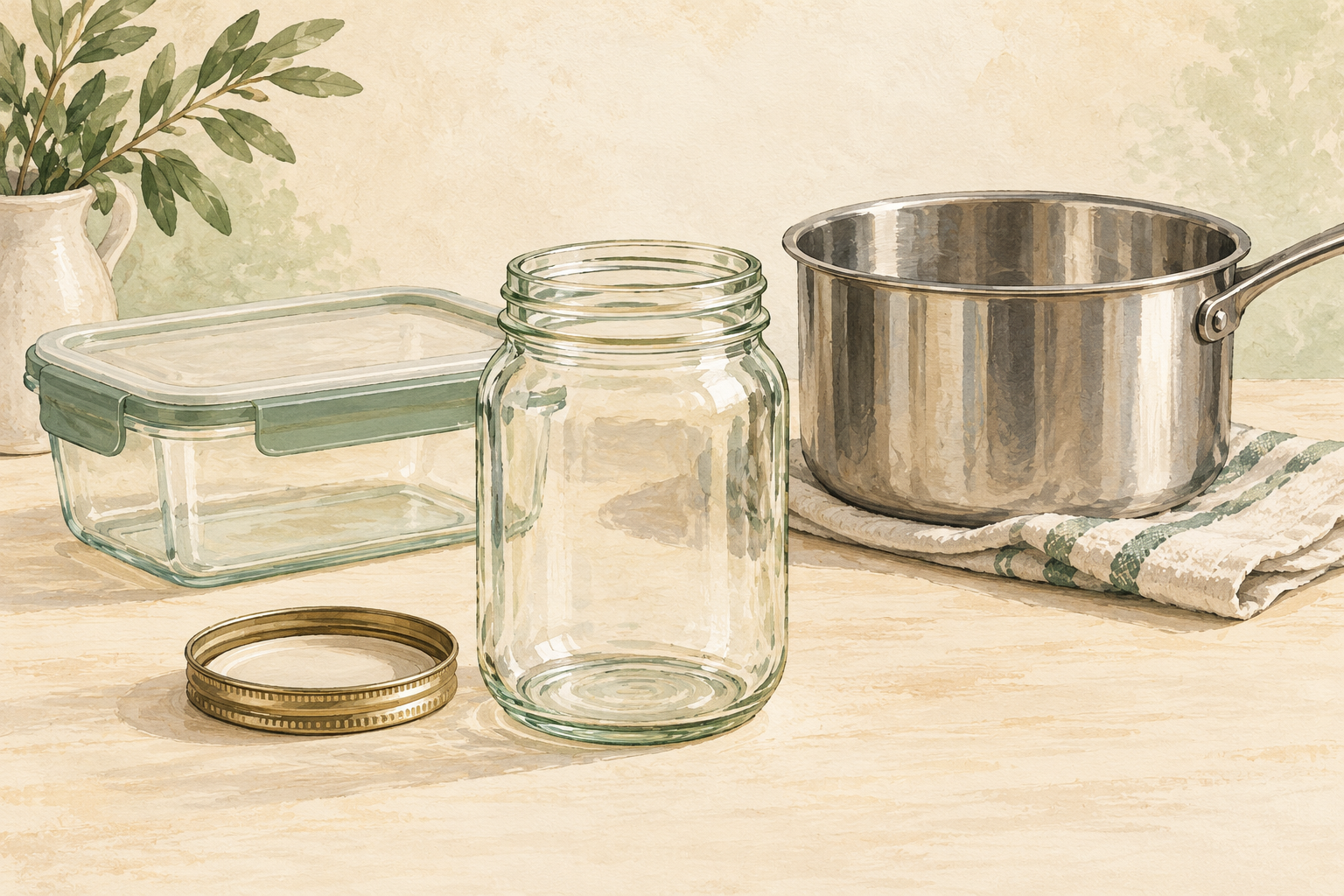
A container has two jobs in a refrigerator-pickle project: hold food safely and make cold storage easy. A decorative jar may do neither well. Choose the recipe first, then choose a container whose material, shape, lid and temperature rating suit the method. This guide covers equipment selection; it is not a canning or fermentation recipe.
Start by identifying the preservation method
A refrigerator recipe stays refrigerated. Putting it into a Mason jar, tightening its lid or hearing a lid pop does not turn it into a shelf-stable preserve. Home canning requires the jars, lids, preparation and processing specified by a tested recipe. Fermentation has separate container and monitoring requirements. If a recipe does not tell you which process it uses, resolve that before shopping for a jar.
Glass: useful when you can inspect it easily
A clear, wide-mouth jar makes it easier to see the food and use a clean utensil without tipping out the whole batch. Before filling, check the rim and body for cracks, chips and damage. Reject damaged glass. Choose a size that holds the recipe’s prepared vegetables and liquid while leaving its specified headspace; the nominal jar capacity is not the same as the amount of vegetables it holds.
Check the manufacturer’s heat instructions. A jar suitable for cold storage is not automatically suitable for warm brine, boiling-water processing or sudden temperature changes. Follow the recipe and container directions rather than pouring hot liquid into an unknown reused bottle.
Plastic: verify the intended use
Use containers identified by their manufacturer as suitable for food contact and the intended acidic food and temperature. A recycling code alone does not describe every permitted use. Avoid containers previously used for chemicals, unknown buckets and badly scratched or damaged tubs. A tight lid can help prevent leaks, but it does not establish preservation safety.
A shallow container can be convenient for short vegetable pieces; a tall narrow tub may be awkward to pack and clean. Check that it fits upright in the refrigerator before filling it. Do not improvise with trash liners or non-food-contact bags.
Metal and lids need separate checks
A suitable non-reactive saucepan, such as food-grade stainless steel, is useful when a recipe calls for heated vinegar brine. Avoid copper, brass, zinc, galvanized metal and damaged reactive surfaces in contact with acidic or salty pickling mixtures. Do not assume every metal bowl or decorative lid has the same construction.
Inspect the inside of the lid as carefully as the container. Replace a rusty, damaged or unsuitable lid with a compatible food-contact lid. Never rely on an improvised seal as evidence that the food can leave the refrigerator.
A five-minute container check
- Read the recipe’s method, yield and container instructions in full.
- Confirm the material’s food-contact and temperature suitability.
- Inspect the rim, lid and all food-contact surfaces for damage.
- Wash and rinse as directed, and keep clean utensils ready.
- Confirm the filled container will fit upright in the refrigerator and can be labelled clearly.
Frequently asked questions
Can I reuse a commercial food jar?
For refrigerated storage, first establish its condition, cleanability, lid compatibility and suitability for the recipe’s filling temperature. Do not treat an ordinary reused commercial jar as an approved canning jar. If its suitability is uncertain, select a container with clear manufacturer instructions.
Does a better jar let me keep pickles longer?
No container upgrade establishes a new storage life. Follow the specific recipe’s storage instructions and keep refrigerator pickles cold. If handling is uncertain, the appearance of a sound jar cannot resolve it.
Sources and related reading
Reviewed 30 October 2026: NCHFP container guidance and NCHFP equipment-related pickle problems. These references do not validate an improvised preservation process.
Continue with washing versus sterilizing jars, refrigerator versus canned pickles, or the Recipe Library. The featured image is an original AI-assisted illustration, not product certification or a photograph of a tested batch.
1 thought on “Containers for Refrigerator Pickles: Glass, Plastic and Metal”